Product Information
The Core Components Of Mobile Concrete Mixing Plant
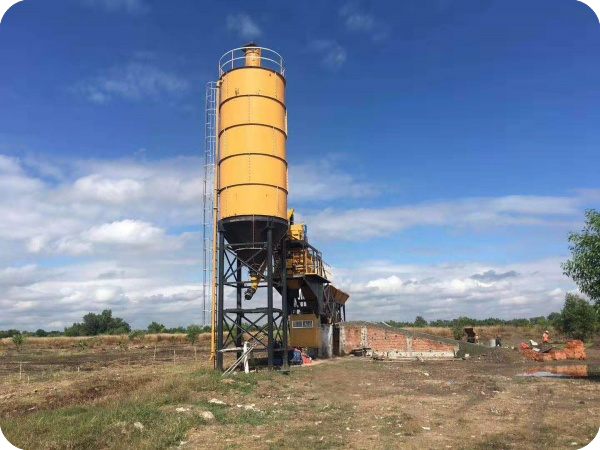
Mixing Host | Forced twin-horizontal or vertical shaft mixer to ensure concrete uniformity (common capacity: 0.5m³~2m³/dish) |
Aggregate Silo | 2~4 storage hoppers (sand and stone storage in different grades), with belt conveyor or forklift loading |
Weighing System | Electronic scales accurately control the ratio of cement, water and aggregate (error ±1%) |
Control System | Fully automatic PLC control, supports manual/automatic switching, and can be remotely monitored |
Mobile Chassis | Trailer type (needs a tractor to move) or self-propelled (with tires/tracks, suitable for complex terrain) |
Water Supply/Additive System | Water tank + water pump, optional admixture metering device |
Main types and selection suggestions
Classification by movement mode
Trailer Forced twin-horizontal or vertical shaft mixer to ensure concrete uniformity (common capacity: 0.5m³~2m³/dish) type (economic type):
Requires truck towing, suitable for flat sites (such as rural road construction).
Representative models: HZS25 (25m³/h), HZS35 (35m³/h).
Self-propelled (high-end type):
Integrated power system, can move by itself over short distances (such as crawler mixing plants).
Suitable for mines and rugged terrain (such as Cemix MC series).
Application scenarios and advantages
Typical applications
Highway/railway construction: Move with the progress of the project to reduce the distance of concrete transportation.
Post-disaster reconstruction: Quickly deploy to disaster areas to provide concrete.
Rural housing construction: Eliminate fixed station investment and reduce costs.
Military engineering: Rapid field construction to support military infrastructure construction.
Core advantages
Quick transfer: can be disassembled and transported to the new site within 1 day.
Cost saving: no need to harden the foundation, reducing civil engineering investment.
Environmental compliance: closed design + dust removal system to meet environmental protection requirements.
Intelligent control: recipe storage, fault alarm, data recording function.
Common problems and maintenance
(1) Common faults
Inaccurate batching: check whether the sensor is calibrated to avoid the influence of aggregate moisture content on weighing.
Mixer jam: clean the agglomerated concrete regularly, especially before shutting down.
Structural deformation during movement: fix the legs and mixer main unit during transportation to avoid bumpy damage.
(2) Daily maintenance
Lubricate the agitator shaft and conveyor belt bearings daily.
Clean the dust collector filter element weekly to prevent clogging.
Empty the water tank and gas tank during long-term shutdown to prevent rust.