
Product Introduction
Core functions of vibrating screen
Classification: Separate materials by particle size (such as coarse, medium and fine particles).
Screening: Remove impurities or unqualified particles (such as grain impurity removal and ore sorting).
Dehydration/de-sludge: Separate solids and liquids (such as sand washing and coal slime treatment).
Solid-liquid separation: Filter solid particles in slurry (such as chemical raw material filtration).
Key structures and components
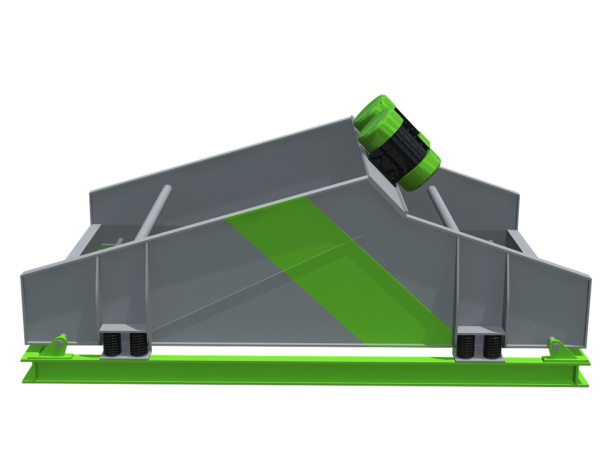
Screen box: Carrying screen and material, need to be wear-resistant (commonly used stainless steel or carbon steel).
Screen: determines the screening accuracy, and the materials include wire mesh, polyurethane, nylon, etc.
Vibration motor/exciter: power source, adjusting the amplitude and frequency can change the screening effect.
Shock-absorbing spring: rubber spring, steel spiral spring, etc., to reduce the vibration transmitted to the foundation.
Support frame: fix the screen body to ensure stability.
Selection points
Material characteristics:
Particle size distribution, moisture content, viscosity, corrosiveness (such as acidic materials require stainless steel screens).
Screening requirements:
Processing capacity (tons/hour), screening efficiency (such as 95% pass rate), number of screen layers (single layer or multi-level classification).
Working environment:
Explosion-proof (chemical), food grade (304/316 stainless steel), high temperature resistant (such as foundry industry).
Special requirements:
Sealed and dustproof (pharmaceuticals), silent design (urban construction), automated connection (assembly line).
Common problems and solutions
Screen blockage:
Reason: material is wet or electrostatically agglomerated.
Solution: Use ultrasonic screen cleaning device or bouncing ball screen cleaning design.
Low screening efficiency:
Reason: amplitude/frequency mismatch or unreasonable screen mesh.
Solution: Adjust vibration parameters or replace screen.
Abnormal vibration of equipment:
Reason: eccentric block of vibrator is loose or bearing is damaged.
Solution: Tighten bolts or replace bearings.
Maintenance and care
Daily inspection: whether the screen is damaged or the bolts are loose.
Regular lubrication: Add high-temperature lithium-based grease to the vibrator bearing every 3 months.
Cleaning: Clean residual materials after shutdown (especially in the food industry).
Screen replacement: Replace in time according to wear and tear to avoid affecting accuracy.
Technology development trend
Intelligence: Install sensors to monitor vibration status and predict faults (such as remote monitoring of the Internet of Things).
Modular design: Quickly replace the screen or vibration unit to reduce downtime.
Energy saving and environmental protection: low power consumption motor, noise reduction technology (such as rubber shock pads).
Example application scenarios:
Mines: Circular vibration screening for iron ore selection (particle size 20-100mm).
Food factory: Rotary vibration screen for flour screening (mesh size 100-200 mesh).
Wastewater treatment: Linear screen for dewatering sludge (processing capacity 50t/h).