Product information
Core functions and features
Efficient dehydration: The pressure can reach 0.4-2.0MPa, significantly reducing the moisture content of the filter cake (such as the moisture content of the pulp after dehydration can be reduced to 15%-25%).
Flexible regulation: Adapt to different material characteristics by adjusting the pressure and filtration time.
Environmental protection and energy saving: Compared with centrifuges, it has lower energy consumption and no dust risk.
Key components and functions
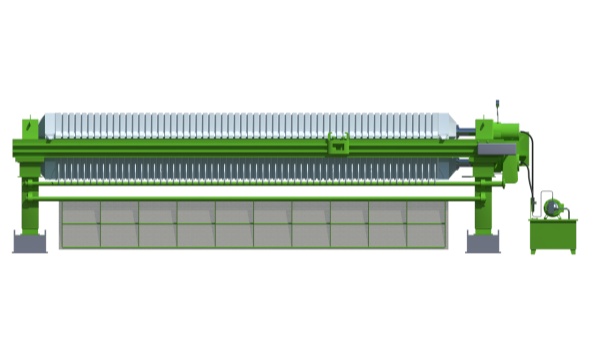
Filter plate/filter frame:
Material: polypropylene (PP), reinforced nylon, stainless steel (corrosion resistant).
Structure: open flow (visible filtrate discharge)/undercurrent (closed pipeline).
Filter cloth:
Selection basis: acid and alkali resistance (such as polyester), temperature resistance (such as polypropylene ≤90℃), air permeability (mesh number).
Hydraulic system:
Provide compression force (usually 10-20MPa), electric hydraulic pump or manual operation.
Control system:
Fully automatic programmable PLC control, realizing the whole process of compaction-feeding-washing-unloading.
Core parameters of model selection
Processing capacity: calculated according to the volume of the filter chamber (L) and the cycle (times/hour).
Filtration pressure: generally 0.6-1.6MPa, and the diaphragm pressing stage can reach 2.0MPa.
Filter cake moisture content: diaphragm filter press is 5%-10% lower than ordinary chamber type.
Special requirements: explosion-proof (chemical industry), high temperature resistant (ceramic industry), aseptic (food grade 304 stainless steel).
Workflow (taking automatic chamber type as an example)
Press the filter plate: the hydraulic cylinder pushes the filter plate to form a closed filter chamber.
Feed pumping: the slurry passes through the filter cloth under pressure, and the solids are intercepted to form a filter cake.
Washing/drying (optional): replace the residual filtrate with clean water or blow with compressed air.
Discharging: Pull the filter plate apart, and the filter cake will fall off automatically (with the aid of a vibrator if necessary).
Common problems and solutions
The filtrate is turbid:
Reason: The filter cloth is damaged or the mesh size does not match.
Solution: Replace the filter cloth or add a pre-coat (such as diatomaceous earth).
The filter cake is not formed:
Reason: Insufficient feed pressure or too fine material particles.
Solution: Increase pump pressure or add flocculants (such as PAC).
Filter plate leakage:
Reason: Sealing surface wear or uneven clamping force.
Solution: Repair the sealing surface or recalibrate the hydraulic system.
Maintenance and optimization
Daily maintenance:
Cleaning the filter cloth (backwashing or ultrasonic cleaning), checking the hydraulic oil level.
Key life parts:
Filter cloth (3-6 months), filter plate (3-5 years), hydraulic seal (1-2 years).
Energy efficiency optimization:
Use variable frequency pump to reduce power consumption, and waste heat recovery to dry the filter cake.
Cutting-edge technology
Intelligent:
Integrated pressure sensor and AI algorithm to optimize filtration cycle in real time (such as Endress+Hauser solution).
New material filter plate:
Carbon fiber reinforced composite material (lightweight + corrosion resistance).
Zero emission design:
Combined with steam drying to achieve full drying of sludge (water content <5%).