
Product Information
Core functions and features
Separation principle: Through tangential feeding, a high-speed rotating flow field is generated, and centrifugal force is used to separate particles of different densities or particle sizes.
Core advantages:
No power consumption (only relying on fluid pressure energy)
Fast processing speed (single unit processing capacity can reach more than 100m³/h)
Multi-stage series connection can be used to improve separation accuracy
Typical applications:
Slurry classification (such as gold and iron ore)
Wastewater treatment (sand removal, oil-water separation)
Chemical industry (catalyst recovery, crystallization separation)
Key structures and working principles
(1) Core components
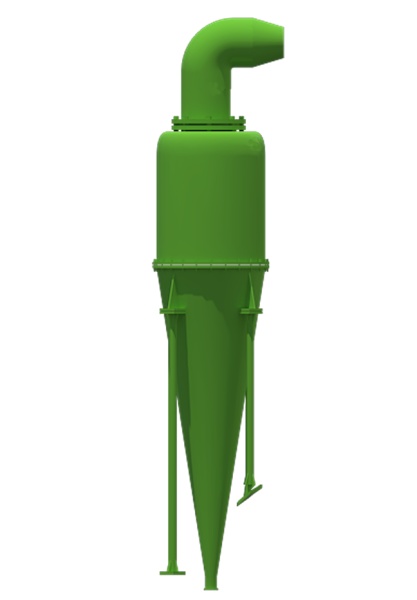
Feed port: tangential feeding to form a vortex (pressure usually requires 0.1-0.4MPa).
Cone: The angle (10°-20°) affects the separation accuracy. The longer the cone section, the better the fine particle separation effect.
Overflow pipe: discharge light phase or fine particles (top).
Underflow port: discharge heavy phase or coarse particles (bottom, the opening can be adjusted to control the discharge concentration).
(2) Separation process
Tangential feeding: The slurry rotates at high speed, generating centrifugal force (up to hundreds of times the gravity).
Classification/separation:
Coarse particles/high-density objects move toward the outer wall and are discharged from the bottom flow port.
Fine particles/low-density objects migrate toward the center and overflow from the overflow pipe.
Parameter control: Optimize the separation effect by adjusting the feed pressure and bottom flow diameter.
Maintenance and optimization
Regular inspection: Wear of the inner wall of the cone and changes in the size of the bottom flow port.
Wear-resistant measures: Ceramic/rubber lining (the service life of mining applications can be extended by 3-5 times).
Intelligent control: Install pressure sensors and automatic valves to adjust the bottom flow opening in real time.
Technology frontier
Microcyclone: used for nanoparticle separation (such as graphene purification).
CFD simulation optimization: Design efficient flow fields through fluid dynamics simulation.
Compound cyclone: Combined with gravity sedimentation (such as cyclone-sedimentation all-in-one machine).